

Your Photos Don't Lie — But They Could Say More
inpixly Team 7 minJan, 32, product manager from Hamburg, showed me his Tinder profile after three weeks of exactly zero matches. The first photo: Him in the bathroom mirror, phone at chest height, a drying rack full of socks behind him. The second: Him at a company party, surrounded by six colleagues — which one was him remained a mystery. The third: A sunset. Without him.
Jan is an attractive guy. In real life, he turns heads. On Tinder, he was invisible. Not because of his face, but because of his photos.
That's the uncomfortable truth nobody wants to hear: On dating apps, you are your photos. Everything else comes later. Or not at all.
Zero Point Three Five Seconds
That's how long the average Tinder user takes to make a swipe decision. Not three seconds. Not one. Less than half a second.
In that time, the other person sees exactly one image. And that image has to contain everything: likability, trust, interest, a hint of "I want to get to know this person." If that image is a mirror selfie with a sock rack, your humor doesn't get a chance. Your intelligence doesn't. Your charm doesn't.
Your photo speaks for you before you can say a word. The only question is: What is it saying?
The Classics That Cost You Matches
The bathroom selfie. The evergreen of dating photo mistakes that simply refuses to die. Mirror, phone, bad lighting, cluttered background. The image doesn't say "Here I am." It says "Five minutes of effort was all I could manage." And five minutes of effort on a platform built on first impressions feels like an insult.
The puzzle group photo. Five people, one table, no idea which one is you. Nobody's going to cross-reference all five through your remaining photos. If your match has to guess, your match swipes on.
The fossil photo. The beach vacation from 2021. Do you still look the same? Maybe. But your match doesn't know that. And uncertainty is the enemy of every right swipe. Current photos signal: I'm showing you who I am now. Old photos signal: My best days are behind me.
The filter graveyard. Dog ears and flower crowns were cute in 2018. In 2026, they say: I don't want to show what I really look like. That's the opposite of what builds trust.
What Actually Works
The research on dating photos is surprisingly clear. Photos that generate matches share a few traits — and none of them require a professional shoot.
Natural light. Daylight makes everyone more attractive. That's not opinion, that's physics. Warm, soft light flatters facial features, creates depth, and feels inviting. Neon light does the opposite. Next time you take a photo: Go to the window.
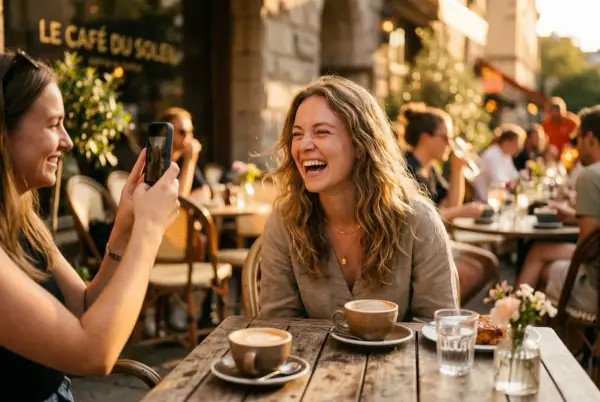
A real smile. Not the forced "cheese" grin where only the mouth smiles and the eyes stay dead. The smile that happens when someone just made you laugh. The difference is subtle in the photo but loud in its impact.
Context. A photo against a white wall is a passport picture. A photo in a cafe, by the river, in your kitchen while cooking — that's a slice of your life. And slices of real life spark curiosity.
Different angles. Not just straight-on into the camera. From the side while laughing. From above while reading. A full-body shot that honestly shows who you are. Different perspectives create a more complete picture — and a complete picture builds trust.
Where the Red Line Is
AI can turn a mediocre photo into a good one. Better light, cleaner background, optimized framing. That's like good post-processing — the difference between an iPhone snapshot and a photo that looks like a friend with a photographer's eye took it.
But there's a clear boundary. Change your face? No. Manipulate your body? No. Place you somewhere you've never been? No. Put a dog next to you that you don't own? Absolutely not.
The rule of thumb: If your date sees you on the street and thinks "Looks like the photos" — perfect. If they think "That's a different person" — you've gone too far.
AI isn't supposed to turn you into someone else. It's supposed to make visible what a bad camera angle or lousy lighting hid. Nothing more. Nothing less.
Every App Is a Different Game
Tinder isn't Bumble isn't Hinge. Using the same photos in the same order on all three is like inviting people to a buffet and serving the same dish at every table.
On Tinder, the first image counts. Period. It needs to be bright, it needs to show your face, it needs to stand out in the crowd. Dark, blurry images disappear in the feed like a whisper in a stadium.
Bumble demands more. Women make the first move, and they need a reason to do it. Your photo needs to offer a conversation hook — you while climbing, cooking, with something someone can write about. Bumble also has photo verification. Make sure your optimized photos are still recognizably you.
Hinge shows photos and prompts together. Here, the combination matters. A great photo with a boring prompt is worth half as much as a good photo with a prompt that invites a response.
The Instagram Effect
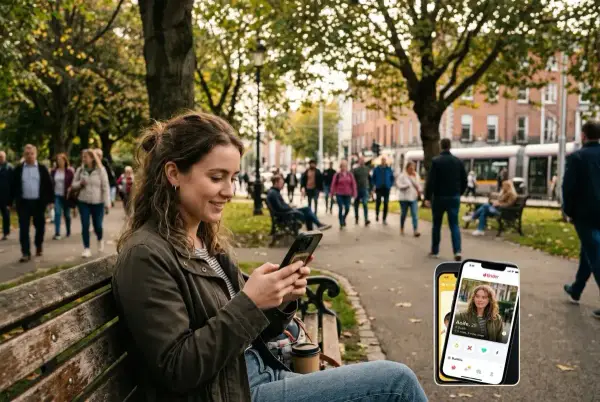
What many overlook: Most dating apps offer the option to link your Instagram. And the majority of users click on it.
Your dating profile has six photos. Your Instagram has everything else. And if a vibrant feed is waiting there — with different facets of your life — it amplifies every good impression your app profile built.
An active Instagram is the extension of your dating profile. The same photos that bring your feed to life can keep your dating profile fresh. And an AI-optimized complete profile — app plus Instagram plus bio — is more than the sum of its parts.
Your Photos Deserve More Than Five Minutes
You spend an hour getting ready for a date. You think about what to wear. You pick the restaurant. You prepare conversation topics.
But your profile — the place where the date becomes possible in the first place — got five half-hearted minutes? Somewhere between brushing your teeth and falling asleep?
That ratio doesn't add up. You know it. And you don't need a photographer or Photoshop to fix it. You just need a system that turns your everyday photos into images that convince in zero point three five seconds.
Frequently Asked Questions
Can AI improve my dating photos without faking them? Yes. AI optimizes lighting, background, and framing — like a friend with a photographer's eye. Your face and body stay unchanged. The rule of thumb: If your date recognizes you on the street, everything's fine.
What photos work best on dating apps? Natural light, a genuine smile, context (cafe, kitchen, outdoors instead of a white wall), and different perspectives. Avoid mirror selfies, puzzle group photos, and outdated images.
Do I need different photos for Tinder, Bumble, and Hinge? Yes. Tinder needs a strong first image, Bumble needs photos with conversation-starter potential, Hinge thrives on the photo-prompt combination. Using the same photos everywhere wastes potential.
How often should I update my dating photos? At least one new photo every two to three months. Current images signal activity to the algorithms and show your match who you are now — not who you were two years ago.