


Cancel the Agency, Keep the Results
inpixly Team 7 minThe painting company Hofer from Graz has 14 employees and an Instagram account. Last year they paid 2,800 euros per month to an agency. Three posts per week, Instagram and LinkedIn.
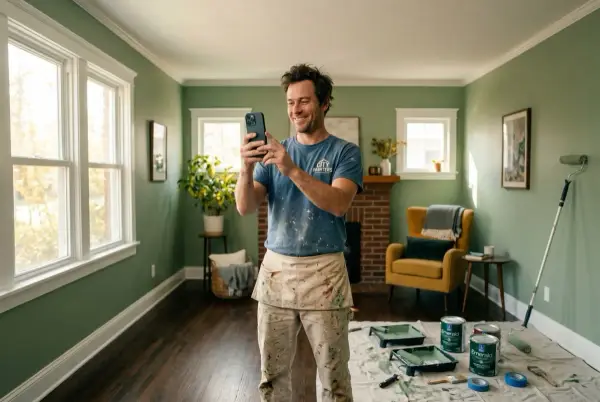
In February, Stefan Hofer showed me the posts. A smiling team in front of a freshly painted wall. Caption: "We love what we do! Color is our passion." Plus three stock-photo hearts as emojis.
"We didn't write that," says Stefan. "And it doesn't sound like us either."
I ask: "Did you give feedback?"
"Three times. The third version was marginally better. Took five days."
Stefan pays 2,800 euros per month for content that sounds like someone who knows his business from the imprint page. That's not an isolated case. That's the industry.
The Structural Problem of Every Agency
Agencies aren't bad companies. They have a bad business model — at least for small and medium-sized clients.
An agency with 30 clients might have five people creating content. Each handles six accounts. For each account, they have 90 minutes per week. In those 90 minutes, they're supposed to understand what drives a painting company in Graz. What the customers want. How Stefan talks. Which projects are running.
That's impossible. So they fall back on what always works: Templates. Stock photos. Sentences that fit everyone and therefore resonate with nobody.
The math is simple. 2,800 euros divided by 12 posts per month: 233 euros per post. For text Stefan would never have written, a stock photo that doesn't show his job site, and a feedback loop that costs more time than the post itself.
What You're Actually Paying For
Not creative work. Structure.
The agency delivers reliability. Every month, 12 posts come in. On time. Formatted. With hashtags. That's valuable — when the alternative is typing captions yourself at 11 PM.
But 2,800 euros for reliability? For someone else pressing the "Publish" button? That's like paying a chauffeur who only parks the car. You still have to drive — in the form of briefings, feedback, coordination.
Stefan did the math: He spends 3 hours per week on agency communication. Writing briefings. Reviewing texts. Taking calls. At his hourly rate: another 960 euros on top. Real costs: almost 3,800 euros per month.
What that looks like compared to all other options is broken down in detail in the social media cost comparison.
The Third Option That Didn't Used to Exist
Before, you had two paths: do it yourself or outsource. Doing it yourself costs time. Outsourcing costs money and authenticity.
Since 2025, there's a third. AI-powered automation. No person in the chain who half-heartedly understands your business. Instead, a system that learns how you write. That knows your humor. That knows Stefan says "surface" and not "facade."
Stefan now sends a photo from the job site via Telegram in the morning. Ten minutes later, a finished post is ready — text, image, hashtags. He taps Approve. Or changes a word. That's it.
No briefing. No call. No five-day feedback loop. The entire process is walked through step by step in the automation guide.
Why a Machine Can Be More Personal Than a Person
Sounds paradoxical. It isn't.
The junior at the agency has 90 minutes per week for Stefan's account. In those 90 minutes, they write texts for a company they've never visited. They know the website, maybe the Instagram profile. Nothing more.
The AI system knows every text Stefan has ever approved. It knows which words he changes and which he leaves. It learns from every correction. After three weeks, the output doesn't sound like a machine — it sounds like Stefan on a Monday morning when the sentences flow.
The agency junior needs months to reach that level. If they even reach it before switching agencies and their replacement starts from zero.
What Stefan Does Differently Since the Switch
Before: 3 hours per week on agency communication. 2,800 euros per month. Posts he didn't like.
After: 15 minutes per week. Send three photos, approve three posts. Cost: a fraction of the agency bill.
But the most important change wasn't the money. It was that his customers started saying: "Hey, your Instagram has gotten really good." Because the posts now sound like Stefan. Like his job sites. His people. His humor.
A customer wrote: "Since when are you doing this yourselves? It's much better than before." Stefan replied: "Since February." He didn't mention AI was involved. Why would he? The content is his. The ideas are his. The system just handles the grunt work.

When You Still Need an Agency
Honesty matters. There are three situations where an agency is the better choice:
First: You're planning a campaign with a five-figure budget, influencers, and event marketing. You need strategic minds, not automation.
Second: Crisis communication. When your company is in the media and every word counts, you want experienced PR people.
Third: You're a completely new brand with zero awareness and need positioning first.
For everything else — the regular posts that keep your business visible — an agency is money down the drain for most companies. How to go fully independent without your feed going empty is covered in the companion article.
The Switch in Practice
Stefan didn't cancel overnight. He ran both in parallel for four weeks.
Weeks 1 and 2: Agency keeps delivering, first AI posts are created in parallel. Compare.
Week 3: Stefan shows three team members two posts each — one from the agency, one from AI. Without saying which is which. All three pick the AI post.
Week 4: Cancellation sent. Three months notice, but the decision was made.
Since May, the Hofer painting company posts three times a week. The feed looks better than ever. The agency bill is history. And Stefan has 12 hours per month back that he used to spend on calls and feedback.
His comment: "I have 14 people. They're painters, not social media managers. And neither am I. Now I don't have to be."
Frequently Asked Questions
What's the best social media agency alternative for small businesses? AI-powered automation where you steer the content without spending hours writing. You send a photo, get a finished post in your style, and approve it in seconds. That saves thousands of euros per month with better quality than generic agency posts.
Is it worth canceling the social media agency? For most small and medium businesses, yes. Agencies cost 2,000 to 5,000 euros monthly plus your own time for briefings and feedback. With automation, you save that budget and get content that actually sounds like you. The cost comparison shows the numbers in detail.
Can AI really create more personal content than an agency? Yes, because the system learns from every approved post and gets to know your style better over time. An agency copywriter handles dozens of accounts at once and has 90 minutes per week for yours. The AI works exclusively with your tone, your topics, and your word choices.
How long does the switch from agency to automation take? Most businesses run both in parallel for two to four weeks and compare results. After that, the decision usually comes quickly. The entire automation workflow is set up within a few days.